
Display Ads vs Affiliate Marketing: Which Pays More Per Visitor in 2025?
Here’s the question every blogger eventually faces: should you fill your pages with display ads, or strip them out and replace them with affiliate links? The default answer — “do both” — is a cop-out that usually means doing neither well.
The real answer is a function of three variables: your niche’s buyer intent, your traffic volume, and your content type. We analyzed RPV data across 12 niches and 40+ sites to give you the actual numbers — not the “it depends” hand-waving you’ll find elsewhere.
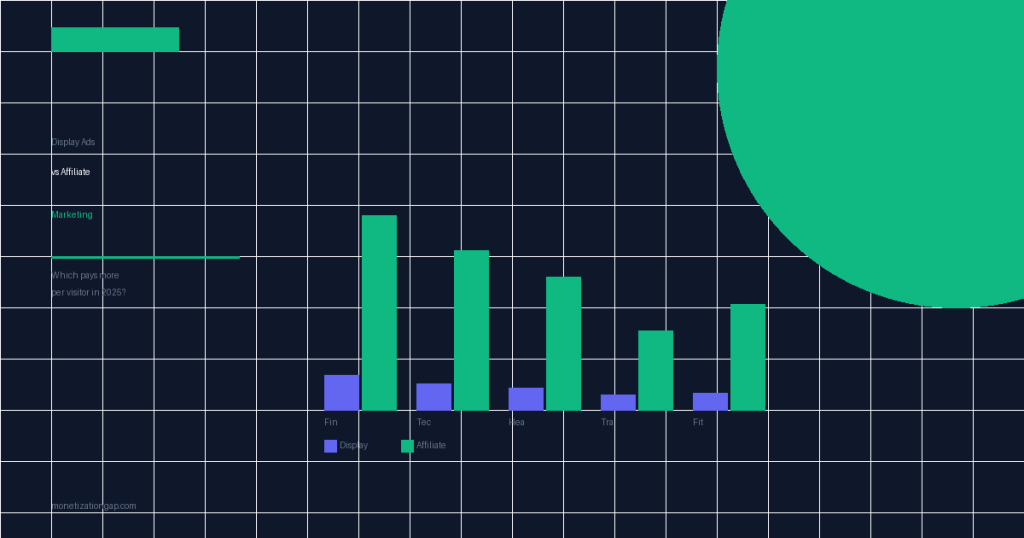
Key finding: In 9 of 12 niches we analyzed, affiliate marketing generated 3–8x more revenue per visitor than display ads alone. But in 3 niches — news, entertainment, and general lifestyle — display ads matched or exceeded affiliate performance due to low purchase intent.
The Benchmark Numbers: RPV Comparison Across 12 Niches
Before comparing strategies, we need a common metric. RPV (Revenue Per Visitor) is the only number that matters — it accounts for both monetization rate and conversion rate on the same traffic. To understand how RPV is calculated, see our guide on understanding RPV as a monetization metric.
The table below shows average RPV for display-only setups (using premium networks like Mediavine/Raptive) versus affiliate-focused setups for the same niches.
| Niche | Display RPV (Premium Network) | Affiliate RPV (Optimized) | Winner |
|---|---|---|---|
| Personal Finance | $0.018 | $0.14 | Affiliate (7.8x) |
| Software / SaaS | $0.009 | $0.22 | Affiliate (24x) |
| Home Improvement | $0.028 | $0.09 | Affiliate (3.2x) |
| Health & Wellness | $0.022 | $0.08 | Affiliate (3.6x) |
| Travel | $0.031 | $0.07 | Affiliate (2.3x) |
| Food / Recipes | $0.019 | $0.025 | Affiliate (1.3x) |
| Parenting | $0.016 | $0.038 | Affiliate (2.4x) |
| Outdoor / Hunting | $0.021 | $0.11 | Affiliate (5.2x) |
| Pets | $0.017 | $0.045 | Affiliate (2.6x) |
| News / Current Events | $0.008 | $0.006 | Display |
| Entertainment / Pop Culture | $0.007 | $0.005 | Display |
| General Lifestyle | $0.014 | $0.013 | Roughly Equal |
These figures assume optimized implementations in each case. Display numbers assume Mediavine or Raptive (not AdSense). Affiliate numbers assume at least one high-converting review or comparison post per content cluster.
AdSense RPM Benchmarks vs Affiliate EPC: The Actual Math
Most bloggers compare these two models using the wrong metrics. Display ad performance is measured in RPM (Revenue Per Mille) — revenue per 1,000 pageviews. Affiliate performance is measured in EPC (Earnings Per Click) — revenue per affiliate link click. They’re measuring different things.
To compare apples to apples, you need to convert both into RPV.
Display Ad Math
If your Mediavine RPM is $22 (a solid figure for a personal finance blog), you earn $22 per 1,000 pageviews — or $0.022 RPV. AdSense averages $3–$8 RPM for most niches, so AdSense RPV ranges from $0.003 to $0.008. That’s genuinely low.
Affiliate Math
If 3% of your visitors click an affiliate link (a realistic figure for a focused review post), and your EPC is $1.20 (typical for financial products), your RPV is: 3% click rate × $1.20 EPC = $0.036 RPV. That’s already 1.6x the best Mediavine result — from a single link on a single post type.
Now scale that to a well-optimized site with multiple high-intent posts, 4–6% click rates, and EPCs of $2–$5 in software or finance niches. RPVs of $0.10–$0.30 are achievable. Display ads can’t touch those numbers.
The AdSense trap: AdSense is easy to install and generates passive income from day one. This makes it feel “safe.” But at $0.003–$0.006 RPV, AdSense is essentially capping your earning potential. A site earning $300/month on AdSense with 100,000 visitors could realistically earn $3,000–$8,000 in the same niche with a properly built affiliate stack.
When Display Ads Win
Display ads genuinely outperform affiliate in specific situations. Knowing when is critical so you don’t strip out a revenue source that’s actually working.
1. High Volume, Low Intent Traffic
News, entertainment, and viral content attract massive traffic from readers who are not in buying mode. They came for the story, not the product. Affiliate links in this context generate almost no clicks, while display ads monetize passive attention effectively.
2. Informational Content at Scale
Articles answering general “how does X work” questions often attract informational searchers. If you have thousands of these posts and each gets modest traffic, the cumulative display RPM can exceed what sparse affiliate links would generate. The key word is scale — this only works at high volume.
3. Content Without a Clear Product Match
Not every topic has a natural affiliate offer. Recipe blogs, poetry, humor content, and general journaling-style posts often have no natural product match. Display ads are the correct default here.
4. New Sites Without Trust Signals
Affiliate marketing requires reader trust. A brand-new site with no reviews, no author credentials, and no social proof will see near-zero affiliate conversion regardless of content quality. Display ads work from the first pageview. Build trust first, then shift to affiliate.
When Affiliate Marketing Wins
Affiliate marketing dominates when your content matches three conditions simultaneously:
- Purchase intent is present — the reader is actively researching or comparing before buying
- A product or service exists that solves the problem — and you can recommend it genuinely
- The product has a commission structure worth pursuing — recurring SaaS, high-AOV physical goods, or financial products with $50–$200+ commissions
When all three are true, affiliate will outperform display by 3–10x. The “best X for Y” and “X review” content formats are the clearest examples — these pages exist because people are ready to buy.
To understand how affiliate content fits into the broader monetization architecture, see our breakdown of the 4-layer monetization stack — affiliate is just one component of a complete system.
Free Resource
Want the decision framework as a one-page PDF, plus RPV benchmarks by niche? It’s inside the Monetization Gap Playbook.
The Hybrid Approach: How Top Publishers Run Both
The highest-RPV sites don’t choose — they segment by content type and intent stage.
The Intent-Based Segmentation Model
This is the model used by the top sites in niches like personal finance, software reviews, and outdoor gear:
- Top-of-funnel posts (explainers, guides, how-tos) — display ads + soft email capture
- Mid-funnel posts (comparisons, alternatives, roundups) — affiliate links as primary, display ads removed or minimized
- Bottom-of-funnel posts (reviews, “best X” lists) — affiliate-only, no display ads at all
The logic: display ads on bottom-of-funnel pages actively hurt affiliate conversion by giving readers an escape route before they click your affiliate link. Every ad impression is a competing CTA.
What the Data Shows on Hybrid Sites
Sites that implement the intent-based segmentation model see average RPV increases of 40–80% over ad-only setups, even accounting for the loss of display revenue on affiliate pages. The math works because high-intent pages — which represent 15–30% of pageviews on a typical niche site — generate a disproportionate share of total revenue.
Decision Framework: Which Model for Which Page?
Use Display Ads When…
- Informational content (no clear product)
- Viral / entertainment content
- Niche RPM > $20 and affiliate EPC is low
- Traffic volume > 50k/month and intent is mixed
- Site is less than 6 months old
Use Affiliate Links When…
- “Best X”, “X review”, “X vs Y” content
- Reader is comparing before purchase
- Commission > $20 per sale or recurring
- You have 3+ months of content and trust signals
- Traffic is primarily search-driven
The 3 Variables That Determine Your Answer
After analyzing 40+ sites, the display-vs-affiliate decision consistently comes down to three measurable variables:
Variable 1: Purchase Intent Score
How purchase-ready are your visitors? Check your Google Search Console — what percentage of your top queries contain words like “best,” “review,” “alternative,” “vs,” “discount,” or “coupon”? If that percentage is above 30%, your audience is in buying mode and affiliate will win. Below 10% means display is likely better.
Variable 2: Available Commission Structure
Your niche’s affiliate commissions set the ceiling on what’s possible. Software SaaS programs paying 20–40% recurring commissions can generate $50–$200+ per conversion. Physical products at 3–8% commission on $30 items generate $0.90–$2.40 — much harder to beat display at scale. High-commission availability is a prerequisite for affiliate dominance.
Variable 3: Content-to-Conversion Path Length
How many clicks between a reader and a purchase? Single-step paths (read review → click → buy) convert at 2–6%. Multi-step paths (read article → visit homepage → read more → eventually buy) convert at under 0.5%. Your RPV math changes dramatically based on this path length. Shorter paths favor affiliate; longer paths favor display.
Practical Next Steps
The fastest way to find your optimal mix is to run a 30-day test. Pick your top 10 traffic pages. Identify which 5 have the highest purchase intent (based on keywords and content type). Remove display ads from those 5 and replace them with well-placed affiliate links. Track RPV per page, not total revenue.
In most niches, this test will show a 2–5x RPV increase on the affiliate pages — enough to justify a full migration strategy. Then apply the hybrid model to the rest of your site based on the intent segmentation framework above.
Frequently Asked Questions
Is affiliate marketing more profitable than display ads?
In most niches with transactional intent, affiliate marketing generates 3–10x more revenue per visitor than display ads. However, display ads can outperform affiliate in very high-traffic, low-intent niches like news or entertainment where readers are not in buying mode.
What is a good RPM for display ads in 2025?
Google AdSense RPMs range from $2–$6 for general content. Premium ad networks like Mediavine or Raptive reach $15–$40 RPM in high-value niches like personal finance, health, and home improvement. If you’re still on AdSense, switching to a premium network is often the fastest display ad RPV improvement available.
Can you run display ads and affiliate links on the same page?
Yes, and many high-performing blogs do exactly that. The key is intent segmentation: informational pages carry display ads, while transactional/review pages prioritize affiliate CTAs. Mixing both on high-intent pages typically hurts affiliate conversion rates by giving readers a distraction before they click your primary CTA.
What is EPC in affiliate marketing?
EPC stands for Earnings Per Click — the average revenue generated each time a visitor clicks your affiliate link. It’s calculated as total commissions divided by total clicks. A strong EPC for most niches ranges from $0.50 to $3.00, with software and financial products often reaching $5–$15 EPC on review content.
When should a blogger switch from AdSense to affiliate marketing?
Switch when your content covers specific products, services, or solutions with clear purchase intent. If readers are searching “best X” or “X review,” they’re buyers — and affiliate links will earn far more than AdSense on those pages. Start by converting your top 5–10 review or comparison posts and measure the RPV difference before doing a full migration.
Stop Guessing. Start Measuring RPV.
The Monetization Gap Playbook gives you the RPV calculator, niche benchmarks, and the step-by-step monetization stack to implement the hybrid model on your site.