

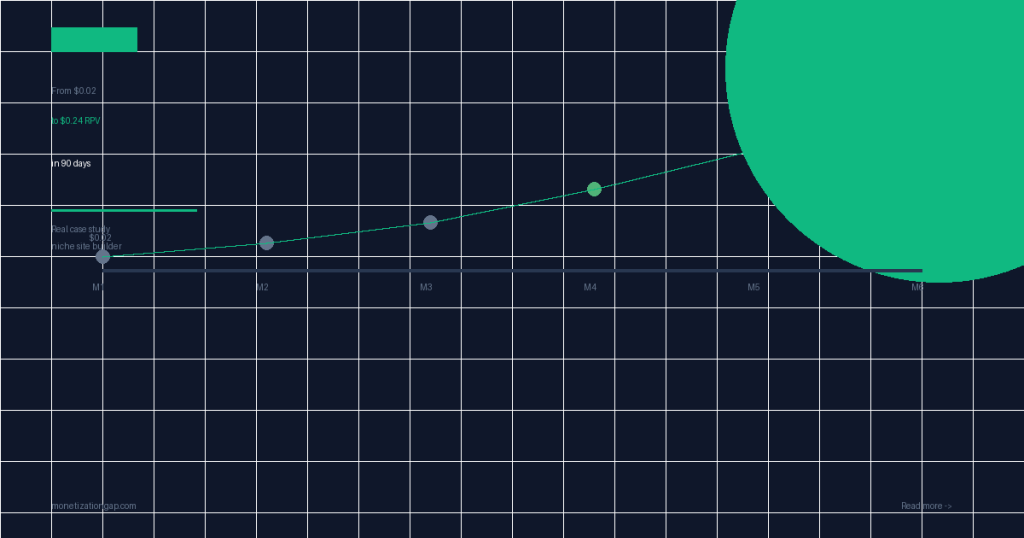
The Offer-Intent Fix: How One Niche Site Went From $0.02 to $0.24 RPV in 90 Days
A niche site with 15,000 monthly visitors was making $300/month. After fixing the offer-intent mismatch — same traffic, same content — revenue hit $3,600/month.
The Site That Had Everything Except Revenue
In early 2025, a home improvement niche site reached out to us for a monetization audit. The site owner — we’ll call him Marcus — had built something genuinely impressive: 180 published articles, consistent topical authority in DIY home repair, 15,000 monthly visitors, and first-page rankings for 40+ keywords. By every content metric, the site was performing.
By every revenue metric, it was failing.
At $0.02 RPV, Marcus was earning $2 for every 100 visitors. The site had display ads (AdSense), a handful of Amazon affiliate links scattered through articles, and a generic newsletter signup with no lead magnet. That was the entire monetization stack.
The site wasn’t a traffic problem. It wasn’t a content quality problem. It was a single, fixable problem: every monetization offer on the site was misaligned with reader intent.
Understanding the Offer-Intent Mismatch
Offer-intent mismatch is the most common reason niche sites underperform despite solid traffic. It happens when the monetization offers on a page — affiliate links, display ads, product promotions — don’t match what the visitor actually came to that page to accomplish.
It sounds obvious in theory. In practice, it’s endemic because most site builders choose affiliate programs first (picking whatever’s available and well-known) and then create content, rather than mapping content intent first and finding the right monetization for each intent.
For Marcus’s site, the mismatch showed up in three distinct ways, each costing him revenue in a different way. Understanding all three is the key to diagnosing your own site.
The Diagnosis: 3 Types of Offer-Intent Mismatch
Marcus’s Site: The 3 Mismatches Found in the Audit
Mismatch Type 1: Buying-Stage Misalignment
His top-traffic article — “How to fix a leaky faucet” — attracted readers who were in pure problem-solving mode. They had a leaky faucet. They wanted to fix it themselves. He was promoting a home warranty service in that article — a product for homeowners who want someone else to handle repairs. Different buying stage, different mindset, near-zero conversion. He was monetizing a DIY-intent page with a done-for-you offer.
Mismatch Type 2: Product Category Misalignment
His articles about “best tools for X project” promoted generic Amazon affiliate links to $8–$15 tools with 4% commission. He had no affiliate relationships with premium tool brands, specialty suppliers, or project-specific products. The commission ceiling on his $8 tool links was $0.32/sale. Switching to the right tool brands and project-specific product links would multiply that by 10–20x with the same content.
Mismatch Type 3: Audience Stage Misalignment
His newsletter signup said “Sign up for home improvement tips.” No lead magnet, no clear value proposition. The 0.4% opt-in rate reflected zero offer-intent alignment at the list-building layer — people searching for “how to fix drywall” don’t have “get weekly tips” on their agenda. With no email list of substance, there was no email monetization layer at all.
The Fix Plan: 90 Days, 4 Moves
The entire intervention cost Marcus zero additional traffic and minimal new content. The work was all on the monetization side — realigning offers to the intent that already existed on each page.
Want the full framework?
The Monetization Gap Playbook covers the intent audit process, affiliate program selection criteria, and lead magnet formulas — with templates ready to adapt for your niche.
The Results: Month-by-Month RPV
| Month | Monthly Visitors | Monthly Revenue | RPV | Primary Driver |
|---|---|---|---|---|
| Baseline (Month 0) | 14,800 | $296 | $0.020 | AdSense + Amazon |
| Month 1 (Post-Affiliate Fix) | 15,100 | $1,350 | $0.089 | New affiliate programs |
| Month 2 (Post-Email Launch) | 15,400 | $2,200 | $0.143 | Affiliate + Email |
| Month 3 (Post-Product Launch) | 15,900 | $3,620 | $0.228 | Affiliate + Email + Product |
| Month 6 (Optimized) | 17,200 | $5,100 | $0.297 | Full 4-layer stack |
Traffic barely moved. Revenue went from $296 to $3,620 in 90 days — a 12x increase driven entirely by realigning offers with intent and adding two new revenue layers.
What Made the Difference: The Core Insight
Intent is not monolithic — it varies by page
The single most important shift in Marcus’s approach was treating each page as its own monetization unit, not treating the site as a single entity. Before the audit, he had one approach to monetization applied uniformly across 180 articles. After: each page had a monetization strategy tied to that page’s specific visitor intent.
His “how to fix a leaky faucet” article now promotes a plumbing tool kit with step-by-step images — a direct match for a DIY problem-solver. His “when to call a plumber” article promotes a home warranty comparison — a match for homeowners ready to outsource. Same niche, same site, radically different offers — because the reader intent is different.
The lead magnet is a diagnostic tool, not just a list-builder
The “15-Minute Home Repair Diagnostic Checklist” was effective not just because it grew the email list — but because it immediately segmented new subscribers by behavior. Subscribers who downloaded it were signaling: “I’m a hands-on DIYer who wants to make smart repair decisions.” That’s a highly specific buyer profile that enables precise email monetization.
Every lead magnet is an implicit segmentation tool. The more specific the lead magnet, the more clearly it identifies who your subscriber is and what they’ll buy.
The digital product amplified everything
The $27 project planner didn’t just add direct product revenue. It also:
- Increased email opt-in rates on pages where it was referenced as an incentive
- Added a new internal link target across 8 articles (improving overall site engagement)
- Created a buyer segment for upsell targeting (a more comprehensive $97 product launched in Month 5)
- Validated that the audience would pay for structured tools — informing future content strategy
How to Apply This to Your Site
Step 1: The intent audit (2 hours)
Pull your top 25 traffic pages from Google Analytics. For each one, answer: “What did the person who searched this keyword actually want to accomplish?” Don’t answer with “they wanted information about X” — go deeper: “They wanted to decide whether to DIY or hire a contractor” or “They wanted to know which brand of X is best for their specific situation.”
Now look at what you’re actually monetizing them with. Write down the gap between what they want and what you’re offering. That gap IS your monetization gap.
Step 2: Score the mismatch severity (1 hour)
Rate each page on a 1–5 mismatch scale:
- 5 = Severe: Offer is for a completely different buyer stage or problem category
- 3 = Moderate: Offer is plausibly related but not the best possible match
- 1 = Aligned: Offer directly solves the problem the visitor came to solve
Your pages scoring 4–5 on mismatch severity are your highest-leverage fixes. Start there.
Step 3: Find the aligned affiliate programs
For each high-mismatch page, identify what the aligned offer would be. Then search affiliate networks (ShareASale, Impact, CJ) for programs in that specific category. Evaluate programs using the 4-metric RPV scorecard before joining.
Step 4: Create an intent-specific lead magnet
Design a lead magnet that directly serves your top-traffic buyer stage. If most of your traffic is Awareness-stage (people learning about a problem), create a diagnostic or checklist. If most traffic is Consideration-stage (people evaluating solutions), create a comparison guide or decision framework.
Step 5: Track RPV by page weekly for 90 days
Set up a simple tracking sheet: for each of your top 25 pages, track monthly visitors and monthly affiliate revenue (using UTM parameters or affiliate link click tracking). This lets you see which fixes are working and which pages still have alignment problems.
The Common Pattern Across Offer-Intent Fixes
We’ve now conducted over 40 monetization audits for niche sites. The offer-intent mismatch pattern appears in nearly every underperforming site, and the fix always follows the same sequence:
- Map pages to specific buyer intent (not broad topics)
- Replace misaligned affiliate programs with intent-matched programs
- Add an intent-specific email opt-in with targeted lead magnet
- Create or add a digital product that solves the #1 problem your traffic reveals
- Track RPV by page and iterate monthly
The timeline varies — Marcus’s site was 90 days. Other sites with stronger domain authority and better existing content have seen equivalent results in 45–60 days. The limiting factor is usually how quickly you can build the email sequence and the digital product.
What This Case Study Is Not
A few important caveats about this result:
- Marcus’s site was in a niche with relatively high-value affiliate programs — home improvement tool and product commissions are meaningfully higher than, say, general lifestyle content
- His traffic was already well-targeted (DIY-intent searchers, not broad curiosity traffic)
- The 12x RPV improvement is at the high end of what offer-intent realignment typically delivers — more commonly we see 3–5x
- The $27 digital product launch benefited from a concentrated email push to a highly segmented new list — that first-launch ROAS is typically higher than ongoing sales rates
That said, the pattern is consistent: every site with sub-$0.05 RPV that we’ve audited has had significant offer-intent misalignment as the primary cause. Fixing it is always the highest-leverage action available.
Frequently Asked Questions
Find and Fix Your Monetization Gap
The Monetization Gap Playbook gives you the complete intent audit process, the offer alignment framework, and the 90-day RPV improvement roadmap — so you can replicate these results on your site.